
When it comes to optimising your fitness level, there aren’t many metrics more inherently connected to your wellness than heart rate. And the best HR monitor, using electrocardiography or photoplethysmography technology, records your heartbeat and sluices that collected information through an algorithm to show up real-time HR value.
Whether you are skiing in the backcountry, hitting trails for hours, or monitoring how well you are recovering from a hard bout of workout or a cardiac incident, heart rate monitoring technology can help you keep your ticker in check with ease.
To unpack our precise guide to select the best heart rate monitors and the list we have rounded up, read on.
What is a Heart Rate Monitor?
A heart rate monitor or HRM is a sensor-based tool used to track and display the wearer’s heartbeat speed (the contraction numbers of the heart per minute) and record it for further analysis.
It also helps calculate multiple systems concurrently: cardiovascular functions (arteries, blood circulation, and heart), pulmonary system (lungs), muscular function (the process of using oxygen by body muscles) – all essential body stats that define your fitness level.
HRMs can be of great use for:
- Athletes
- Runers
- Skiers, climbers, and hikers
- Triathletes
- Cyclists
- Injury-rehabilitation patients
- Weight-loss participants and more
How Does an HRM Work?
HRMs can be of mainly two types based on their working process:
- Chest-strap HRMs and
- Optical HRMs
Let’s look into how these two types of HRMs work:
Chest Strap HRM
A chest-strap HRM is a wireless HR sensing device that operates based on electrocardiography to track your heartbeat/minute. It includes a strap-like band, a tiny pad that houses electrodes, and a snap-on transmitter.
The electrodes, when you exercise, receive the vital electric signals emitted by your heart and transmit the data to its detachable transmitter.
The microprocessor inside the device further analyses the electric signal, and the transmitter constantly transmits the analysed data to the dedicated mobile application connected to the HRM via Bluetooth.
The app operates as the receiver, displays the heartbeat/minute interactively, and saves it for a specific period.
Avant-garde chest-strap HRMs also sync with other wearables besides mobile devices.
Wrist-based HRMs
Most wrist HRMs work based on optical sensor technology/PPG and house tiny LEDs that illuminate your arteries and track blood circulation by shining lights of varying wavelengths onto your wrist skin.
These lights react distinctly with the blood circulating underneath the skin, resulting in light reflection/refraction.
The receiver in the optical sensor accumulates the data given off by the reflecting/refracting light and transmits it to the photodetector to decipher it as binary 1 and 0. The data translated by the photodetector and accelerometer (motion data) is then fed into the PPG algorithm for analysis and showing meaningful motion-tolerant pulse data.
Why to use HR monitors?
The standard resting HR for grown-ups varies between 60 and 100 bpm. And the rule of thumb is that the lower the pulse reading is, the fitter you are (within the range of normal HR).
Let’s dive into the reasons for scanning your heart rate data as a significant part of your workout regime.
- Helps Boost Your Fitness Level: Besides precisely recording your RHR (Resting Heart Rate), top-end HRMs also follow up on your cardiovascular fitness – you can track what specific rate zone you are exercising in, for how much time you can maintain it, the time your heart rate needs to back to normal after the training ends and the progress you’ve made to hit your rate zone goal.
- Measures Your Workout Effort: Data never lies! If you’ve been loafing away a whole week or two in parting really hard and stuffed your face with tempting food, your RHR reading would, no doubt, reflect it and probably motivate you to push yourself a little harder during workouts to get back on track faster – thanks to HRMs that help keep a close eye on your heart’s work-rate more accurately than manual processes.
- You Can Workout Safely: The constant feedback from your HRM ensures you don’t overexert yourself while working out.
How to Choose the Best HR Monitor?
Fitness isn’t merely about how long you workout for; it’s also about how intense activity you go through. An HRM is your pacer, informing you when to let up or go for a vigorous workout to hit the set targets.
Check out our complete guide to strategically investing in the best HRM that suits your lifestyle:
Accuracy
Cash in on a high-level dedicated HRM if you need to ensure you are working out in a distinct rate zone.
Dedicated HRMs like chest-strap monitors are highly precise and offer more exact results than standalone ones.
Though smartwatches or fitness bands can track a whole host of functions and body stats, they lag when it comes down to precision in monitoring heart rate.
Must-have Features
While a basic HRM can notify you of low, high, and irregular HRs, more sophisticated trackers come with built-in GPS with navigation functionalities to continuously ping locations and track the distance you have covered besides HR tracking.
Some must-have features you cannot ignore while shopping for an HRM include:
- Multiple target time zone support
- Smartwatch mode
- Recovery HR mode
- Bluetooth connectivity
- Lap/split times and stopwatch
- A calorie counter
Display
Go for an HRM that comes with a large, bright display with quality contrast, text, numbers, and effortless typing. Having a backlight is a big plus – backlight makes it more effortless for wearers to get a quick glimpse of the readings in low-light environments.

Best HR Monitors
Let’s take a look at some of the best heart rate monitors available on the market today:
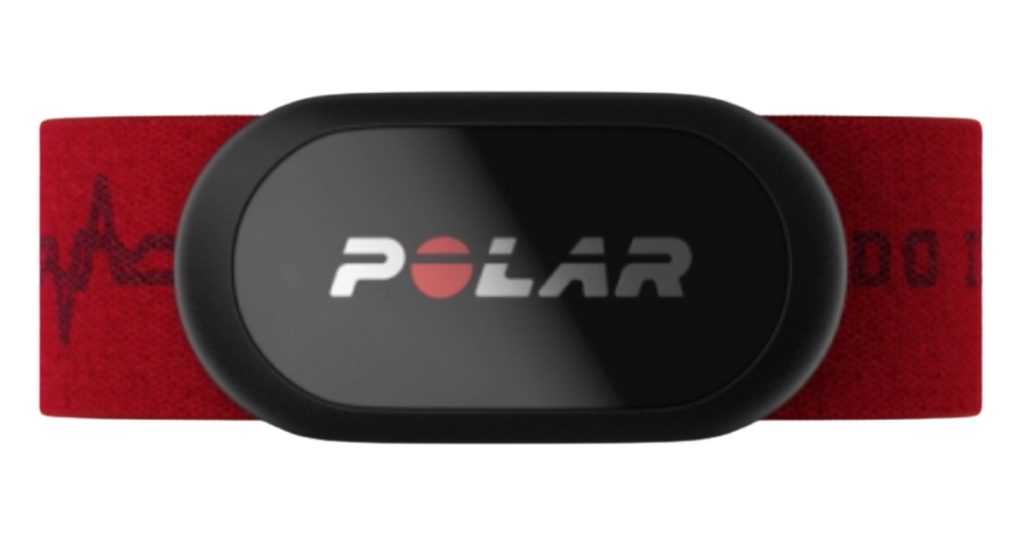
Polar H10 Heart Rate Monitor
Key Features
Built upon Polar’s legacy electrocardiography technology featuring 5kHz transmission, the Polar H10 can be your go-to choice when it comes to precisely tracking and monitoring your heart rate.
Coming with a wide spectrum of band sizes, this high-end chest-strap HR monitor employs the latest silicon quantum dots and buckle-based ‘Pro Strap’ to make it more convenient to put on while still keeping the electrode pad sitting against your chest comfortably and providing precise pulse reading.
Plus, it can seamlessly connect to a wide range of smartwatches – Polar, Apple, Garmin, Suunto, etc.
Pros
- 30m water-resistance rating to make it secure for a deep dip
- Supports both ANT+ and Bluetooth Smart connectivity
- It comes with a free Polar Flow app and website that effortlessly sync with third-party training apps like Nike, Training Club, Strava, Peloton, etc.
- Machine-washable strap
Cons
- Battery life isn’t great
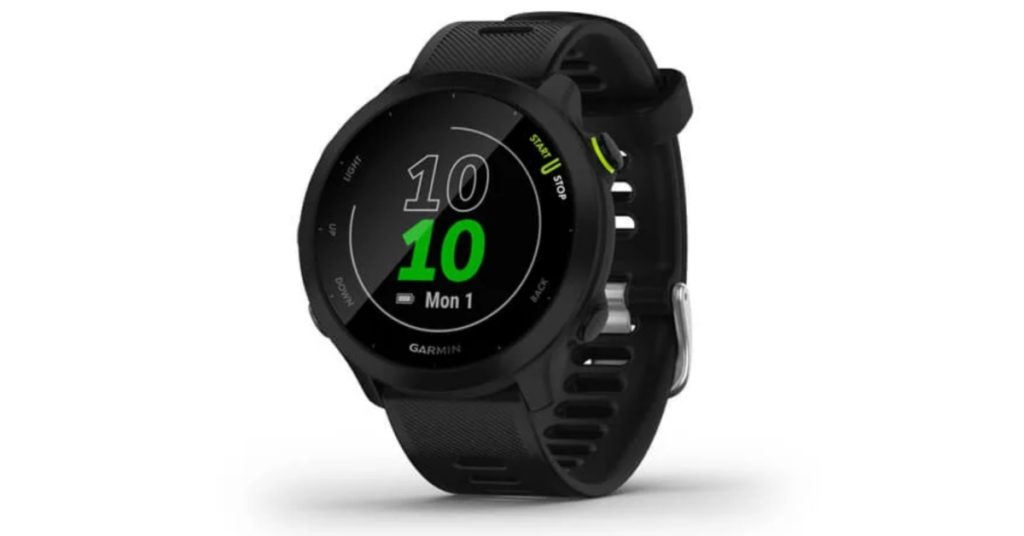
Garmin Forerunner 55
Key Features
If you need an impressive and versatile wrist-based HRM that can offer the best bang for the buck, you’ll be hard-pressed to get a more sweeping device than the Garmin Forerunner 55.
As an upgrade to the Garmin Forerunner 45, this entry-level fitness tracker with the optical sensor-based heart rate monitor built on Garmin’s Elevate technology is speedily pumping out premium HRMs, coming with hefty price tags.
Though it isn’t packed with many bells and whistles like Garmin’s other top-end fitness trackers, it’s the best HRM in its price bracket with no-frills run monitoring.
It can be the ultimate pick for beginners and pro runners who need to track the basics.
Pros
- Sleek, lightweight, compact, and convenient to wear
- Has features like heart rate mode, triathlon mode, VO2 Max reading, daily workout suggestions, built-in respiration, stress, fitness, and women’s health tracking, etc
- Supports full Connect IQ
- Abnormal heart rate alert support
- Swim-proof up to 50m
Cons
- No SpO2 measurement supported
- No built-in altimeter
MyZone MZ-Switch

Key Features
MyZone MZ-Switch is a highly versatile dual-sensor technology-based heart-rate monitor (Optical and ECG) with marquee features – thanks to its 3-way wearable straps – you can put it on your wrist, arm, or chest even while swimming.
Pros
- Seamlessly syncs with a whole host of sports devices and tools – Peloton bikes, Strava, MyFitnessPal, MapMyRun, Garmin, Apple Watch, etc
- Swim-proof up to 30m
- Up to 36 hours of workout data storage are available
- built-in light indicator to help track your heart rate zone with ease
Cons
- The companion app is a little cluttered.
- On the expensive side

Christian Scott is the founder and director of MindBodyFit, a website dedicated to providing the latest information on fitness, health, and mental well-being technology. With over six years of experience in the health and fitness industry, Christian is a passionate fitness enthusiast who combines his love for technology and wellness to help others achieve their best selves.