
Polar H10 vs. Garmin HRM Pro; two brilliant heart rate monitors that are available on the market today. But which one is best?
Heart rate monitors are on a continued upsurge—they are like your pacer, efficiently informing you when to pump your heart up or pull it back to help reach your target fitness level.
By accurately monitoring your health matrices and offering a real-time snapshot of your heart health, a quality HRM ensures your fitness is well-optimised and you can keep your ticker up.
Polar HR 10 and Garmin HRM-Pro are two top-tier models among training enthusiasts and pro athletes.
But which one can offer the best bang for the buck?
Let’s go through Polar HR 10 vs. Garmin HRM Pro to make the best choice.
What is a Heart Rate Monitor?
A heart-rate monitor is a sensor-based personal monitoring system that can efficiently track your heart rate, also known as beat/minute (the number of times your heart contracts in a minute to pump oxygenated blood to the entire body). It also records the monitored data for future analysis by integrating with the company-specific mobile application.
Besides monitoring heart rate, cardiovascular abnormalities, and irregularities in heart rhythms, a quality HRM can also keep track of your muscular function, pulmonary system, sleep time, cadence, blood pressure, HRV, calorie burnt, SpO2 in blood, and other essential body metrics. Thus it helps define your fitness level and understand how fast your body can heal from an exhaustive bout of exercise.
Wearing an HRM and monitoring heart rate can be effective for:
- endurance athletes
- cyclists
- people with cardiovascular issues
- hikers
- triathletes
- runners
- climbers
- joggers
- skiers
- walkers
How Does an HRM Work?
HRMs can be of two types:
- Chest-strap HRM and
- Wrist-based wearables
Let’s dive deeper into how these two types of HRM work:
Chest-strap Heart Rate Monitor
A chest strap HRM is a belt-like wireless device with a strap band that houses a small electrode pad where the sensors sit. The sensors sense, and measure your heart’s electrical activity as it beats (bpm). The device sits against your chest and works based on electrocardiography (ECG) technology.
As you sweat or exercise, the electrode pad in the device picks up the amplified electric impulses given off by your heart muscle and sends them to the built-in detachable snap-on transmitter. The transmitter is attached to the strap and includes a microprocessor to analyse, decipher and record the bpm signal transmitted by the sensors at a rate of 60 Hz. Via ANT+/Bluetooth connectivity, the transmitter constantly sends the processed HR data to the dedicated mobile application that operates as the receiver and displays it.
Wrist-based HRM
Wrist-based wearables are the mainstream HRMs that operate based on PPG (Photoplethysmography) technology — a non-invasive and inexpensive technique for gleaning the volumetric variations in blood flow running on optical sensors.
The OHRMs sit onto your wrist and give off green light waves from the LEDs (light-emitting diodes). The lights react differently with the tissue and skin layers because of their varying wavelengths.
They illuminate the blood vessels and reflect/refract from the circulating blood. The photodetector captures the reflected light signals and gleans the RBC concentration change data in the blood as the blood-circulation dynamics vary with the constant expansion and contraction of your blood vessels. It then encodes the captured signals into ‘0’ and ‘1’ to help software algorithms precisely decode the real HR value.
The value of the analysed signals by the photodetector and the motion data gauged by the inbuilt accelerometer is input into a PPG algorithm that deciphers the motion-tolerant HR data, R-R interval, VO2 value, and more.
Like chest-strap HRMs, wrist HRMs also come with mobile apps or integrate with third-party health tracking apps to help effortlessly keep your ticker in check.
Benefits of Using Heart Rate Monitors
It’s not that you must put on an HRM all the time while doing a workout. What’s significant is identifying the health metrics you need to keep track of, especially while exercising. And whether you are an endurance athlete, skiing deeper into the wilderness, running on trails for hours, or simply need to monitor your resting heart rate, using an HRM can be the most convenient option.
Now let’s look into how a quality heart rate monitor can help you level up your physical condition.
Monitor Your Fitness Level
As we have already stated, HRMs are your reliable source for tracking your fitness condition that can constantly send health feedback. They periodically evaluate and notify you how well your cardiovascular system can work while you are in training. Though your HR monitor won’t suggest what workout you should get into, how you can do it correctly, and the process to balance out exercise with nutrition intake and sleep duration, the feedback data it constantly gives can assist you in setting a workout regimen tailored to your body stats and fitness level.
Get the Most Out of Your Workout
With an HRM, you can be assured that you are getting the best benefits from your exercise and working out at the right intensity — it notifies you whether you are pushing your body too hard or can push it a little harder to hit the THR zone. Most higher-end HRMs come with an alarm feature on the lower and maximum HR limit so you can quickly adjust your workout intensity and ensure you’re working out in a safe HR zone and not over-exerting yourself.
Let’s see how.
When your heart beats too fast (Anaerobic Zone), your body muscles don’t get enough oxygen for efficient metabolism. Thus lactic acid buildup takes place and makes your muscles get acidic. In such a case, you must stop overexerting your body and slow down the training intensity until your muscles completely break down the already formed lactic acid to avoid underlying injuries and maximise workout efficiency. It’s where an HRM comes into use. It indicates if your heart rate, while working out, is in the safe zone or not. So you can have a quick glimpse of your HR value on your HRM monitor and decide whether you can continue the activity session or need to take a bout of a break to recover. Plus, as you know about your Maximum Heart Rate (MHR), you can efficiently customise your workout HRZ and follow them to boost your workout efficacy.
Track Your Progress
Some top-end heart rate monitoring systems can record and show data of workout sessions for a couple of weeks. So you can efficiently tweak your training routine by pinpointing the errors or simply keep you motivated to be on track by putting the fire back in your routine.
Stay Healthy, Burn Calories!
We know that HRMs are no longer devices that merely monitor your heart rate. By accumulating health data, they glean a whole host of fitness metrics. For instance, by monitoring your HR value with an HRM, you can identify the source your muscles are exploiting energy from while working out.
With increasing HR, the quantity of calories your body burns also increases. The truth is, as your HR upsurges, your muscles expedite more carbohydrates than fat. Tracking your HR with an HRM is inevitable here to make essential modifications in your energy output. So you can ensure optimum caloric expenditure and burn fat rather than carbohydrate.

Why Choose a Dedicated Heart Rate Monitor?
Users who need to monitor their heart rate precisely should pick a dedicated system over a standalone one. Dedicated HRMs — specifically chest strap ones — are more precise than optical sensors, coming with other devices, like sports watches, fitness trackers, etc.
Let’s look into how dedicated HRMs outperform standalone systems:
- Most standalone HR monitors come with only ANT+, an interoperable system for wireless data transfer. It has been around since before Bluetooth entered the market and is slower than Bluetooth. The best thing is that dedicated HRMs support ANT+ and Bluetooth connectivity simultaneously. An HRM with ANT+ and Bluetooth functionality is more sophisticated and offers high-level flexibility if you need your HR monitor data to sync over to external apps and devices.
- Unlike standalone HR monitors, most avant-garde dedicated HRMs come with extended battery life, allowing you to use them for weeks or even months without undergoing the hassle of recharging or replacing the battery.
- As most dedicated HRMs come with built-in internal memory, they can record and store multiple training details in real-time — VHR, HR reading, calorie exp[enditure, walking distance, and more. Overwrite the data if you want or store it for future analysis — the choice is yours!
How to Choose a Heart Rate Monitor?
A quality HRM should be an integral part of your workout regimen for a healthy heart. But with the market bustling with tons of products, choosing the best one that can better match your fitness level and requirements can be tricky. We have compiled a comprehensive guide to help you invest in the most suitable HRM.
- Easy to Use: No matter how dapper an HRM looks, unless it’s easy to use and manage, it’s for no use. So, cash in on a high-end device that is feature-packed and easily navigable. Spend on a device that can be assembled in no time, comes with clear instructions, and warranty, and features that don’t require you to be a rocket scientist to master and use.
- Reading Should be Easily Visible: Investing in an HRM that comes with a cumbersome display is a big fat NO. Even some of the ‘best of breed’ and premium HRM models with hefty price tags make HR value small and challenging to read. Always go for a device with a luminous, big display with quality text, contrast, numbers, and effortless typing. Buying an HRM with a backlight is a big plus — you can easily have a quick look at your body stat metrics even in low-light conditions.
- Responsive: Make sure you spend on a high-quality and responsive device that can show your heart rate data in real-time. So you can track your heart rate variability (HRV) and ward off underlying injuries, overstress, and meet goals effortlessly.
- Count on Accuracy: An HRM is not just for tracking how fast your heart is beating, it’s like your personal coach that can demonstrate how fit you are. As we have already said, wrist-based HRMs lag chest straps in accuracy. While optical HRMs measure your pulse to determine your heart rate, electric HRMs sense the variation in your blood circulation with precision and accuracy. Further, buying an HRM that can be paired with various external apps and training equipment is always a plus.
- Count on Comfort: Invest in an HRM coming with a high-quality, comfortable yet durable chest strap. Make sure it features multiple size ranges and is adjustable in size to ensure the sensor module snugly sits against your chest skin and is always in place to show accurate results.
- THR zone Functionality: Go with a high-end HRM model that features THR zone functionality — exercising in a target heart rate zone tailored to your current fitness level and physical condition is critical to ensure your training is highly effective and safe. Understanding how hard you can push your body during a workout can help crack your fitness goal effortlessly. As we have already said, you can better track your THR zone with a top-end HRM. So when it goes above or below a set HR, the device immediately sends alarms.
- Look for the Must-have Features: Your HRM is much more than an indicator of your heart rate value. Look for the following features that make a quality HRM package:
- Recovery HR monitoring
- Pulse monitoring
- built-in GPS to track pace and distance covered
- Calorie counter
- lap/split times or stopwatch
- Tethering for seamless pairing with your smartphone
- Fitness trainer
- Coded transmitter to help avoid crosstalk and interfacing with other HR devices
- Battery replacement
Polar H10 vs. Garmin HRM Pro Which one to Choose?
Polar HR 10 and Garmin HRM-Pro are two chart-topping chest-strap heart rate monitors constantly pumping out other extravagant premium smartwatches with bells and whistles.
But Polar HR 10 vs. Garmin HRM Pro, which one can be the best choice and meet your requirements better?
Here’s a rundown of the differences between these top-tier HRM models:
Polar HR 10

Accuracy
The Polar HR 10 operates based on a constant electrocardiogram. Hence, it is far more precise than wrist-based wearables running on PPG technology.
The Polar HR 10 is highly accurate while showing your HR reading. The feature that makes HR 10 stand out from the pack is its Orthostatic Test functionality if paired with a Polar Watch—a high-level and exact tool that helps athletes balance healing and exercise.
Design
The Polar HR 10 comes in a spectrum of colours and sizes to pick from.
It has a detachable inbuilt transmitter and a comfortable fabric-made band-like adjustable strap. In the centre, there lies an elliptical module, on which sits the electrode pad to ensure your HR data gets sensed and measured precisely with no interference. The small form factor and minimal design make these HRMs highly resilient and effortlessly manageable.
With the Polar HR 10, you get two size ranges to choose from
Thanks to silicone dots and the high-quality buckle system, the HR 10 ensures the strap sits firmly but comfortably.
Features
Polar HR 10 is great for athletes that are in strenuous training. HR 10, being water-resistant up to 30m, can also be used while swimming, as the chest strap comes with non-slip silicone dots to ensure the sensor sits in the right place, you don’t have to spend on a high-end swimming watch to follow up on your swimming metrics.
The H10 doesn’t exist in isolation, of course — it sits within a broader Polar heart rate monitor lineup that includes its predecessor, the H7. While the H10 builds on that legacy with improved electrode contact and expanded Bluetooth connectivity, the two models share enough common ground that choosing between them isn’t always straightforward. Our Polar H7 and H10 side-by-side comparison breaks down exactly where the differences matter most, which can help you decide whether upgrading from an older device is worth the extra spend.
The Polar HR 10 also offers built-in internal memory to auto-save your activity session details. It means you can keep hitting your goals, concentrate fully on your training, and still track the workout efficiency even if your phone is away.
With Polar HR 10, you can store training session data of up to 30 hours.
Connectivity
Your HR 10 device offers an array of connectivity options. You can pair it with your smartwatch and a whole bunch of sports and gym gear — with HR 10’s ANT+ broadcast and two concurrent Bluetooth links, you’re truly spoilt for the pick!
However, you can get the most from your HR 10 monitor when it connects with the Polar Beat app. Offering 130+ training profiles to pick from, it lets you go with your preferred workout and get customised data about your sport-specific metrics for the most efficient training session.
You can get your workout data synced automatically with the Polar Beat or Polar Flow app in HR 10.
Battery Life
Equipped with a lithium coin non-rechargeable (CR2025) battery, your HR 10’s battery won’t run short of juice for up to 400 hours. You’ll also get a two-year replacement guarantee on your HR 10 heart rate device.
Price
HR 10 is available at Polar UK and Polar UK for a retail price of £76.50/$89.95.
You can also buy one from third-party vendors online, which may be cheaper.
Garmin HRM Pro
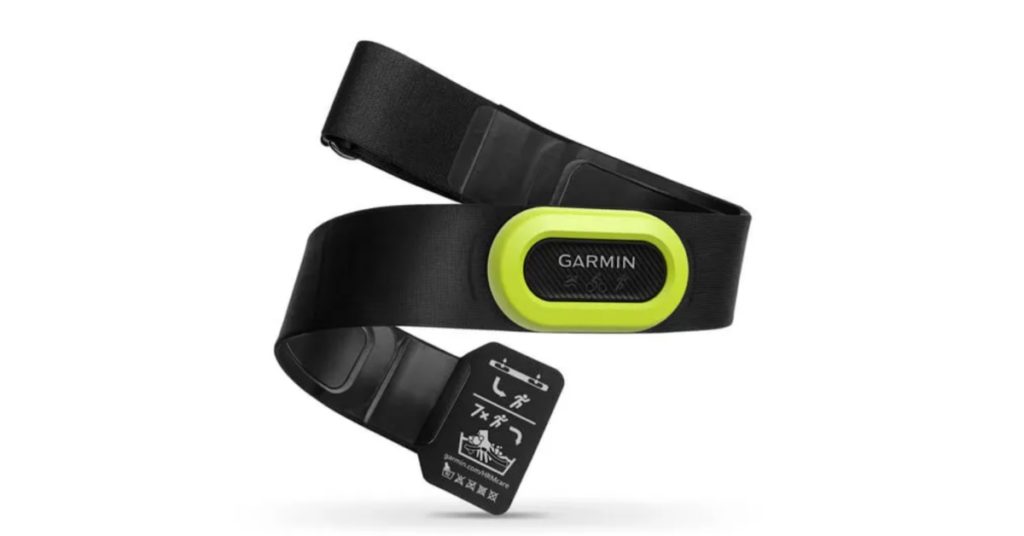
With Garmin HRM Pro, you can keep an expert eye on all critical running metrics except running power as it also operates on a constant electrocardiogram. Plus, if you pair it with a smartwatch from the Garmin group, it can show more in-depth running details. For instance, while integrated with a Garmin smartwatch for runners, HRM Pro can constantly ping locations to track outdoor positions. You can even use your HRM Pro to figure out where your anaerobic (lactate) threshold lies based on your HR and speed (Garmin Lactate Threshold test).
Design
The Garmin HRM Pro is divided into two parts: a detachable integrated transmitter and a comfortable fabric-made band-like adjustable strap. In the centre is an elliptical module on which the electrode pad sits to ensure that your HR data is sensed and measured precisely and without interference.
The Garmin HRM Pro comes in only one size. It is also convenient to put on and carry.
The HRM Pro strap comes in black only, however.
Features
The Garmin HRM Pro is more runner-focused and better suited for triathletes.
The best part is that the HRM Pro is waterproof up to 50 m, and if connected with a compatible running smartwatch, you can even use it as a swim watch!
The HRM-PRO brings together everything essential a user could want in a chest-strap HR monitoring device — heart rate, speed, cadence, GPS tracking, and plenty more!
Garmin HRM Pro also offers built-in internal memory to auto-save your activity session details. It means you can keep hitting your goals, concentrate fully on your training, and still track your workout efficiency even if your phone is away.
With the Garmin HRM Pro, you can save up to 18+ hours of data locally on the device.
Connectivity
Using BLUETOOTH® Low Energy technology and Garmin’s ANT+® connectivity, you can link, sync, and send your activity data over a compatible third-party application (Strava, Nike+, Yes.Fit, etc.).
While Garmin HRM Pro lets you access your historic training data via Garmin’s company-specific mobile app, Garmin Connect, or a compatible connected watch.
Battery Life
If you are looking for an HRM with a longer battery life, the HRM Pro could be the best deal.
Using its lithium coin non-rechargeable (CR2025) battery, with HRM Pro, you get a battery life of 12 months if used for a maximum of one hour per day. Because the battery is long-lasting, you can put it on while doing long workouts, whether a full day of outdoor adventure or an ultramarathon-the HRM-Pro will never quit on you!
With Garmin, you get a warranty of 12 months on the chest strap.
Price
The Garmin HRM-Pro is available at Garmin UK and Garmin US for a retail price of £119.99/$129.99.
You can also buy them from third-party vendors online.
Polar H10 vs Garmin HRM Pro: The Verdict
If you are asking for the best between these two that can offer the best value for your hard-earned money, Polar HR is, no, doubt, the answer.
But if you already own a Garmin watch and need to track more sophisticated running metrics and performance, you should go with Garmin HRM Pro.
Garmin is indeed a market-leading product offering all the top-notch functionalities from Garmin’s lineup of HRMs.
It is a highly accurate, robust, and high-end HR monitoring machine with a super-durable and sleek strap, but it works best when connected with devices from the Garmin ecosystem.
It’s where HR 10 supersedes HRM Pro. From Polar’s own lineup to external services, Polar HR 10 can seamlessly sync with a whole host of sports and gym apps and devices.

Christian Scott is the founder and director of MindBodyFit, a website dedicated to providing the latest information on fitness, health, and mental well-being technology. With over six years of experience in the health and fitness industry, Christian is a passionate fitness enthusiast who combines his love for technology and wellness to help others achieve their best selves.