
Some games pull you forward with loot drops and XP bars. Others pull you forward with something older and more powerful: the need to know what’s around the next corner. Curiosity isn’t a personality trait that some players happen to have. It’s a designable, repeatable reward mechanism that the best game designers build deliberately into every world they create.
Key Takeaways
- Curiosity functions as a structured reward loop, not a vague motivational quality.
- The brain’s dopamine system responds to the anticipation of discovery, not just the discovery itself.
- Extrinsic rewards like loot and XP create engagement spikes that fade; curiosity sustains itself.
- The 40-second rule describes how frequently games must trigger new curiosity to retain players.
- You can actively train curiosity-driven play by turning off map markers and asking “what happens if.”
Curiosity Is Not a Bonus: It Is the Reward System
Curiosity functions as an intrinsic reward loop, not a supplement to external incentives. George Loewenstein’s information gap theory frames it precisely: when you perceive a gap between what you know and what you want to know, your brain treats that gap the same way it treats hunger. It demands resolution. Games that understand this build engagement from the inside out, creating a drive that doesn’t require a scheduled reward to sustain itself.
The loop follows a consistent structure: trigger, seek, resolve, re-trigger. A designer plants a visible mystery. You move toward it. The resolution opens two more questions. The loop restarts. Design breakdowns from Jinderman Publishing research trace exactly how this cycle gets engineered into level layout and pacing decisions. When this cycle runs cleanly, players describe losing track of time entirely, which is the clearest signal that curiosity has replaced conscious decision-making as the engine of play.
The Neuroscience Behind Why Curiosity Feels Good
Dopamine and the Anticipation Window
Dopamine release is triggered by the anticipation of discovery, not just the discovery itself. This is the mechanism that makes curiosity self-sustaining in a way that loot drops and XP bars cannot replicate. When you see a locked door in Dark Souls with no obvious key nearby, your dopamine system activates before you’ve found anything. The seeking behavior is the reward.
This is why the moment before you open a chest in Outer Wilds often feels more electric than the moment after. The information gap is doing the neurological work. Once it closes, the brain needs a new gap to maintain that activation level. Well-designed games anticipate this and layer mysteries so that resolving one immediately opens another.
Epistemic vs. Perceptual Curiosity
Researchers distinguish between two types of curiosity that manifest differently in game design. Epistemic curiosity is knowledge-seeking: you want to understand the lore, the system, the story. Perceptual curiosity is sensory novelty: you heard a sound from the next room, you saw a light flicker at the edge of the map. Both types activate the seek-reward loop, but designers target them with different tools. Environmental storytelling and cryptic lore items feed epistemic curiosity. Sound design, partial visibility, and architectural sight lines trigger perceptual curiosity. The strongest games layer both simultaneously.
How Game Designers Engineer Curiosity at the World Level
Environmental Storytelling and Sight Lines
Environmental storytelling plants visible mysteries that pull players forward without explicit instruction. A distant mountain in The Elder Scrolls series isn’t just scenery. It’s a question: what’s up there? Todd Howard has described this design philosophy as building a world that rewards curiosity in any direction. That’s a structural commitment, not a feature toggle. Every sight line, every partially visible area, every unexplained ruin is a deliberate curiosity trigger placed by a designer who understands the information gap.
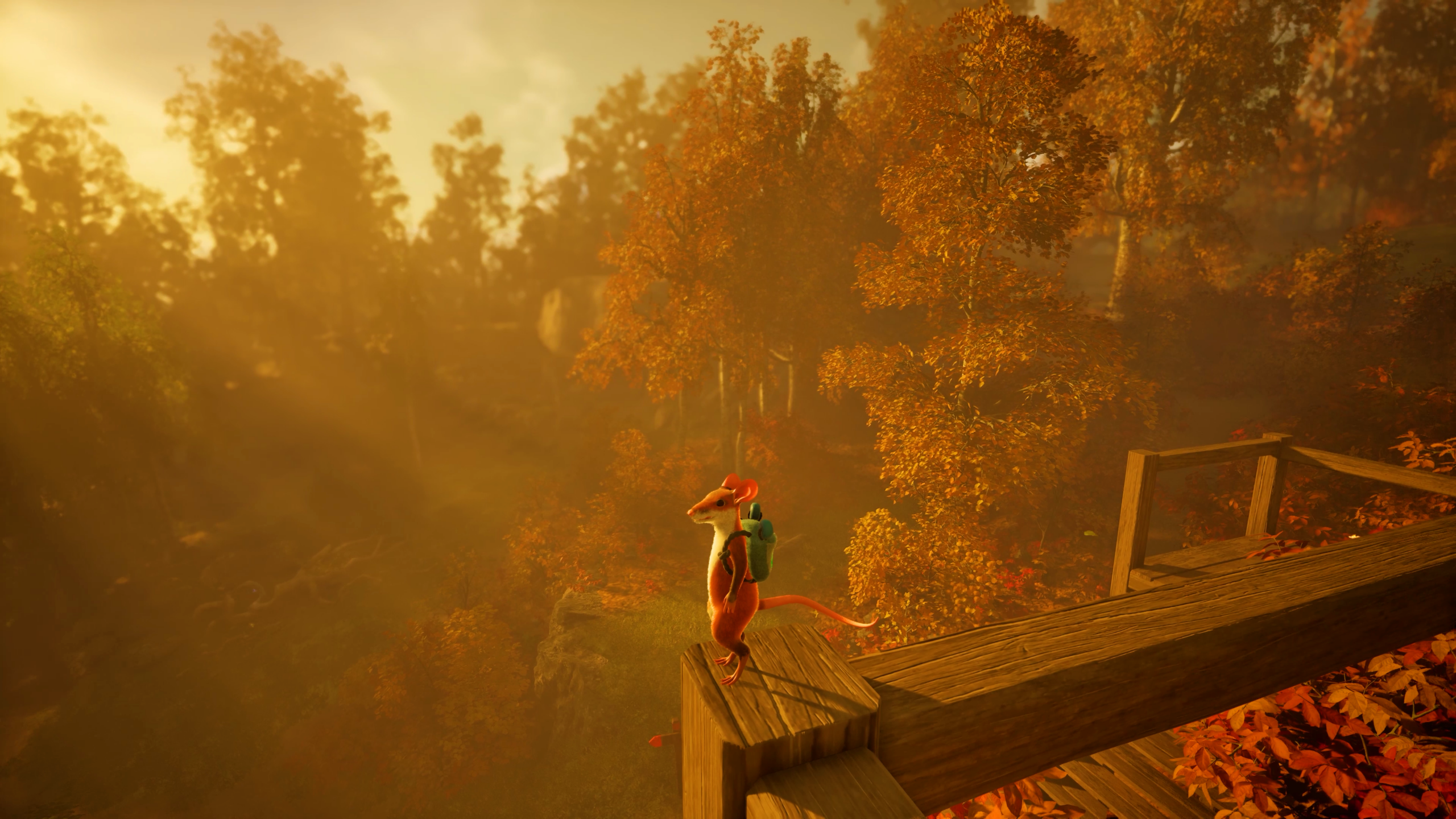
Environmental storytelling works at any scale. In Hela: Of Mice & Magic, glide across the canopy with your Froggy backpack, and the tree line ahead becomes its own open question, what’s forageable past that ridge, what’s waiting to be befriended in the next clearing. Because the world is built for self-paced wandering rather than a fixed critical path, the player supplies the direction, and curiosity does the rest.
Partial Information as a Design Tool
Partial information is one of the most reliable curiosity triggers in game design. A map that shows terrain but hides points of interest. A character who answers three of your four questions. A cutscene that ends one beat too early. Each of these is a designed information gap, and each one activates the same neurological seek response. The designer’s job is to control the size of the gap: large enough to create drive, small enough that resolution feels achievable.
Hela uses this restraint too. The witch’s recipe book tells you what a remedy needs, not where to find it, so a listed ingredient sends you off into the forest without a marked route. In one hands-on preview, players had to notice that a required ingredient only showed up clearly after they shifted the world to evening, since it glowed in the dark. The gap between “here’s the ingredient” and “here’s where it actually is” is exactly the kind of small, solvable mystery that keeps a self-paced world from feeling aimless.
The 40-Second Rule and Curiosity Pacing
The 40-second rule describes how games must deliver a new curiosity trigger within roughly 40 seconds to sustain player engagement. This isn’t a hard scientific law, but it reflects a practical truth about attention: the curiosity loop needs regular fuel. When players go longer than 40 seconds without a new question, a new visual hook, or a new piece of partial information, the loop stalls. Players don’t always quit immediately. They just stop leaning forward.
Pacing curiosity correctly means layering mysteries rather than resolving them sequentially. Breath of the Wild masters this. You’re climbing a tower when you spot a shrine in the valley below. You’re heading to the shrine when a Korok puzzle catches your eye. You’re solving the puzzle when a distant Guardian activates. At no point does the game let the information gap fully close before opening a new one. That’s deliberate pacing, not happy accident.
Curiosity vs. Extrinsic Rewards: Why Points and Loot Fall Short
| Dimension | Curiosity-Driven Mechanics | Extrinsic Reward Systems |
|---|---|---|
| Longevity | Self-sustaining across sessions | Fades as reward cadence becomes predictable |
| Player Autonomy | High, player chooses what to pursue | Low, system dictates reward timing |
| Emotional Depth | Discovery feels personal and earned | Reward feels scheduled and generic |
| Replayability | High, new questions emerge each playthrough | Low once rewards are collected |
| Designer Control | Requires structural world design commitment | Easier to implement, easier to exhaust |
Extrinsic rewards like XP and loot create engagement spikes but erode intrinsic motivation over time. When the reward is predictable, curiosity collapses. Players shift from exploration to optimization: they stop asking “what’s out there” and start asking “what’s the fastest path to the next drop.” That shift marks the moment a game stops feeling alive.
Five Reasons Curiosity Beats Extrinsic Rewards in Games
- Curiosity is self-renewing. Each resolved question opens new ones, so the motivation cycle doesn’t require external replenishment.
- Curiosity scales with player investment. The more you know about a game world, the more interesting the gaps become, unlike loot which loses novelty as your inventory fills.
- Curiosity produces variable reward. You never know exactly what you’ll find, which is the most psychologically potent reinforcement schedule available to designers.
- Curiosity survives completion. Players return to curiosity-driven games after finishing them; they rarely return to games where all the loot has been collected.
- Curiosity transfers to mastery. Players curious about how a game works, not just what it contains, develop deeper skill and longer engagement than those chasing achievements.
Hela leans into exactly this. There’s no XP bar counting your progress and no loot table to empty, just a forest that keeps giving you reasons to look further, something to forage, someone to befriend, a ridge worth gliding to. The reward is finding out, not being handed a number.
Frequently Asked Questions About Curiosity in Game Design
Why is curiosity more effective than loot boxes?
Loot boxes deliver a scheduled, predictable reward that satisfies briefly and then requires replenishment. Curiosity generates its own fuel by opening new questions each time one closes. The information gap theory explains why: your brain treats unresolved gaps as active drives, not passive preferences. Loot satisfies a want; curiosity resolves a need, then immediately creates another.
How do game designers create curiosity loops?
Designers create curiosity loops by controlling information deliberately. They make things visible before they’re accessible, audible before they’re visible, and understandable before they’re fully explained. Sight lines, partial maps, cryptic lore items, and environmental storytelling all plant information gaps that activate the seek-resolve-re-trigger cycle without explicit instruction.
What games use curiosity as a primary mechanic?
Outer Wilds builds its entire structure around epistemic curiosity: every system in the game is a question waiting to be understood. Dark Souls uses perceptual and epistemic curiosity through environmental mystery and cryptic lore. Breath of the Wild uses sight lines and open traversal to trigger curiosity in any direction a player looks. These games treat curiosity as architecture, not decoration.
What makes a discovery feel rewarding versus hollow?
A rewarding discovery answers a question you were genuinely asking, then opens a new one. A hollow discovery closes a gap without creating another, or worse, reveals that the gap was never meaningful. The quality of the payoff matters, but the quality of the question matters just as much.another, or worse, reveals that the gap was never meaningful. The quality of the payoff matters, but the quality of the question matters just as much.

Christian Scott is the founder and director of MindBodyFit, a website dedicated to providing the latest information on fitness, health, and mental well-being technology. With over six years of experience in the health and fitness industry, Christian is a passionate fitness enthusiast who combines his love for technology and wellness to help others achieve their best selves.